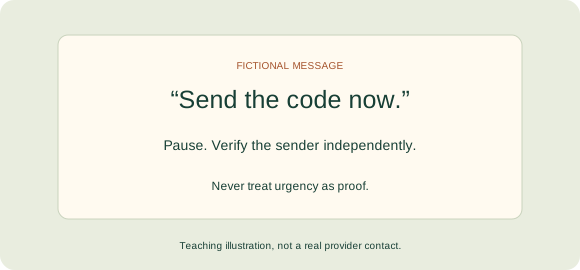
The example is a fictional pedagogical model
The text message presented below is an invented teaching example designed to demonstrate common social engineering patterns. It does not represent a real message from an official app publisher, a specific contact recommendation, or an official record of a security breach.
The primary objective is to critically examine the underlying requests rather than judging the linguistic quality. A polished tone, polite greeting, or familiar brand logo can never independently verify the authenticity of a sender.
Deconstructing deceptive requests line by line
| Message Segment | Underlying Psychological Tactic | What a User Should Notice |
|---|---|---|
| “Your account needs urgent verification” | Artificial Urgency | Pressure is deliberately applied to make an ordinary pause feel costly or risky. |
| “Send the code from your phone” | Credential Theft (OTP/Password) | The demand targets sensitive security tokens or passwords, not an explanation of a technical issue. |
| “Payment will release the hold” | Extortion / False Fees | An unexpected financial transaction is presented as an obligatory condition for service restoration. |
| “Please act now” | Isolation & Compliance | The sender aggressively discourages independent channel verification or consultation. |
No single phrase functions as a universal threat-detection test. The safer operational habit is to analyze precisely what the contact wants you to disclose or execute, and then independently verify that necessity through a separate, trusted pathway.
Always rely on channels independent of the incoming message
Never treat an unsolicited support message as the sole authority for its own contact details or legitimacy. Always initiate communication using a provider channel that you have independently verified beforehand. This represents the fundamental difference between auditing a claim versus blindly following instructions dictated by an unknown claimant.
Official consumer protection guidance from agencies such as the Federal Trade Commission (FTC) emphasizes the critical importance of independently verifying communications that demand personal data or immediate action. While this core principle applies universally across digital platforms, this guide does not assert that every commercial app publisher utilizes identical support workflows.
Immediate containment steps if you have already responded
If you have inadvertently engaged with a suspicious contact or disclosed sensitive data, immediately terminate the interaction. Access your accounts or financial institutions exclusively via independently verified, trusted routes. Document the incident accurately without publicly broadcasting private credentials or account IDs.
Appropriate recovery procedures depend entirely on which specific account, application, or financial channel was compromised. PattiCheck is an independent educational portal and cannot recover lost funds, reverse unauthorized transactions, or act as customer support for commercial apps.
The strict boundaries of an independent educational website
PattiCheck operates no account registration, wallet balance, or user verification services. We have no legitimate requirement for your passwords, login OTP codes, identity verification documents, or banking details simply to explain traditional card rules or Android application telemetry.
For broader contextual frameworks, review our account safety guide. If an Safe Download contact demands remote device control or suspicious system permissions, consult our Android safety telemetry.
Sources & reading notes
Sources checked 27 October 2026. References support the stated context, not an endorsement of an app or service. How we use sources.