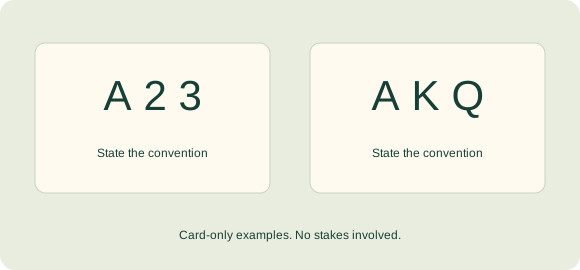
Different rule compendiums can apply distinct ace conventions
When reviewing traditional card literature or digital rulebooks, you may notice that one source positions an A–2–3 sequence (Ace-low straight) above an A–K–Q sequence (Ace-high straight), while another reverses or modifies the hierarchy[cite: 1, 2]. Before assuming a particular source or reference chart is incorrect, it is essential to identify which specific rule convention governs that format. Because aces can function flexibly as high or low cards, short or unaccredited references often introduce ambiguity by leaving foundational ordering unstated.
To maintain analytical clarity and avoid arbitrary assumptions, our primary hand reference chart utilizes a neutral mid-rank configuration (such as 9–8–7) to explain sequence categories without imposing an unstated convention regarding the ace.
Distinguishing basic card categories from internal ranking structures
Evaluating a three-card hand requires a two-step analytical process: first, determine whether the cards form a recognized structural category (such as a pure sequence or a standard sequence); second, check the internal ranking rules specified by the governing compendium. Conflating these two steps is a common source of confusion among beginners.
In standard high-hand configurations, a pure sequence (straight flush) and an ordinary sequence belong to entirely separate evaluative tiers. Debates or variations regarding whether an Ace-low or Ace-high sequence holds superior weight do not alter the underlying category distinction between suited and unsuited consecutive runs[cite: 1, 2].
A structured paper exercise requiring zero stakes
Reinforce your card literacy through a safe, paper-only analytical exercise. Write down A♠ 2♠ 3♠ on one line and A♥ K♥ Q♥ on another. Both examples illustrate consecutive ranks within a single suit, but their relative valuation depends entirely on the stated convention of the house or rulebook[cite: 1, 2]. Explicitly label both lines with the note: “ace ordering convention must be formally stated.”
Next, write down 9♦ 8♦ 7♦. This third example allows you to study pure sequence categorization directly without entangling your analysis in ace-hierarchy debates. No real-money transaction, account login, wager, or outcome prediction is involved or required.
Avoiding informal assumptions and wraparound rules
The presence of an Ace in a deck does not imply that arbitrary groupings become valid sequences. For example, a combination such as K–A–2 should never be assumed to form a legal straight sequence unless explicit documentation for that specialized variant explicitly permits it. Any unconventional or wraparound interpretation requires unambiguous support within the governing rule set.
Similarly, never attempt to resolve ambiguous ties by inventing an arbitrary suit hierarchy. Always verify whether the official rulebook outlines a precise tie-breaking protocol rather than treating the aesthetic color or symbol of a card suit as a procedural instruction[cite: 1].
How to evaluate and construct useful reference charts
A reliable reference guide clearly identifies its format, explicitly defines how aces are ordered within sequences, and distinguishes standard card combinations from wild-card or joker variants[cite: 1, 2]. A concise clarifying note can permanently prevent widespread misunderstandings.
If a specific application or digital mode implements a custom convention, document that setting precisely rather than modifying a universal chart as if local rules applied globally. Safe Download image captures lacking a clear source or operational scope represent weak rule references.
For further study, consult our six-hand recognition chart for category fundamentals and the variation guide to examine how standard assumptions can adapt across different house rules.
Sources & reading notes
- Pagat: Teen Patti rules and documented variations[cite: 1] ↗
- Wikipedia: Teen Patti terminology and variations[cite: 2] ↗
Sources checked 27 October 2026. References support the stated context, not an endorsement of an app or service. How we use sources.